
Why Your Company Needs Fixed Asset Management Software
Your accounting system records what your assets are worth. VemaFATS shows where they are, who has them, and what condition they’re in.

Technology Partners



100+
companies rely on VemaFATS
Finally — software built specifically for fixed assets.
Your Books Record the Value.
VemaFATS Verifies the Asset.
An accounting system solves only part of the fixed asset challenge. Do any of these sound familiar?
Assets Spread Across Sites?
Locations and status are rarely up to date.
No Clear Custodian?
Nobody knows who holds each asset, or when it changed hands.
Inconsistent Asset Data?
Different names, codes, and categories make reports unreliable.
Insurance and Tax Out of Line?
When records don’t match physical assets, premiums and tax calculations go wrong.
Physical Counts Take Too Long?
Manual checks are slow and still prone to discrepancies.
Assets Missing Without a Trace?
With no movement history, investigations stall.
Uncontrolled Asset Transfers?
Assets move, but the records and paperwork stay behind.
Buying What You Already Own?
Untracked assets lead to unnecessary repurchases.
If any of these sound familiar, your current records lack the verification and tracking your assets need.
Fixed Asset Management Takes More Than Record-Keeping
Many companies assume they already have an asset management system because their assets are listed in Excel, an accounting application, or an ERP.
In practice, that data is often poorly structured, making assets hard to locate in the field — and the recorded quantity and value frequently differ from what physically exists.
Sound fixed asset management rests on two foundations: well-structured records and on-site verification through regular physical counts.
Know What You Own
Accurate records are the starting point of a reliable asset register. Without a standardized structure, even basic questions become hard to answer: What do we own? What type, how many, when was it acquired, and at what cost?
Prove What You Own
Once assets are recorded, you need proof they actually exist. Verification confirms where each asset is, who is using it, and what condition it’s in, based on what is found on site. Without it, your reports rest on assumptions. Physical counts close that gap with facts.
Why Companies Choose VemaFATS
All-in-One Asset Platform
Recording, tracking, audits, and reporting in a single solution.
Cleaner Asset Records
A standardized data structure that’s easy to use and scales with your business.
Faster Physical Counts
Scan barcodes or QR codes and verify assets right where they are.
Audit-Ready, Always
A complete asset trail and recorded history make every discrepancy traceable.
How VemaFATS Works
Four steps to managing and tracking your assets
1. Register
Workflow
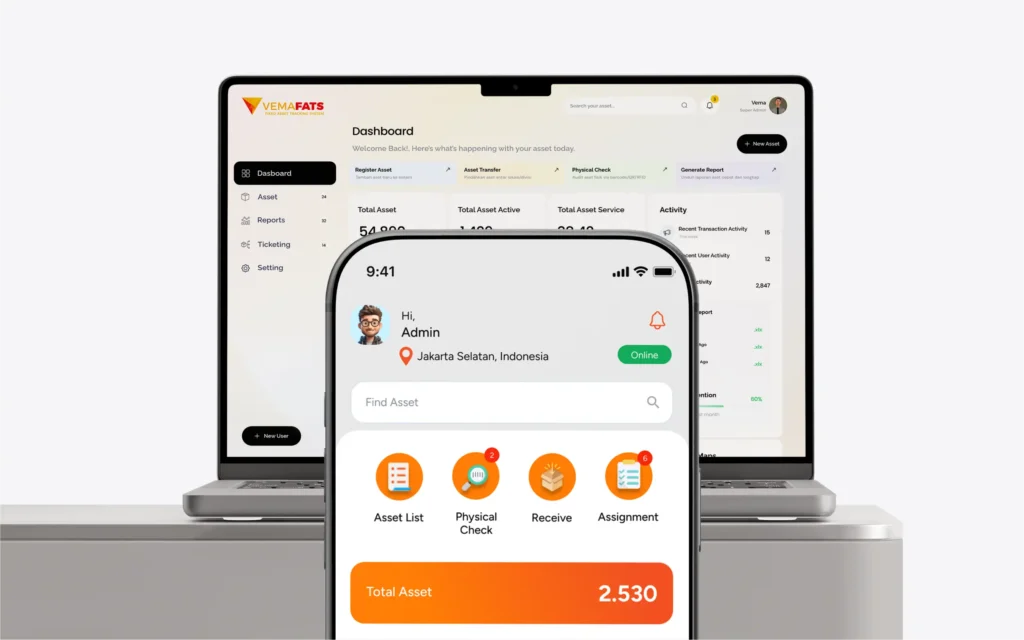
- Existing asset data is collected, reconciled, validated, and uploaded to the system. New assets are entered directly through the Register menu.
- Add supporting details such as location, condition, assigned user, classification, category, photos, and useful life.
- All records are stored centrally in the system.
- VemaFATS generates a unique ID for every asset.
2. Manage
Workflow
- Every asset activity is tracked and recorded.
- Changes are processed through the Transaction menu, with configurable request-and-approval workflows for each transaction type.
- Once approved, records update automatically and the full transaction history is retained.
3. Audit
Workflow
- The administrator creates and schedules count tasks in the system.
- Tasks sync automatically to field devices, where staff scan assets using smartphones, handheld terminals, or RFID readers.
- Scan results from QR codes, RFID, or BLE tags are received and synchronized automatically.
4. Real-Time Reporting
Workflow
- Open the Report menu, apply the filters you need, and the system generates the report instantly.
- Schedule reports for automatic delivery, or preview and print them using any combination of filters.
What Changes With VemaFATS
One Source of Truth
Every team works from the same data, with every update recorded and traceable.
Scan Once, Synced Instantly
Physical counts move faster, results compile automatically, and discrepancies
surface immediately.
Location and Status, Always Clear
Know where every asset is and what condition it’s in, at any moment.
Every Transfer and Handover on Record
Assets no longer simply disappear, and discrepancies are far easier to investigate.
Book Value, Backed by Physical Evidence
Gaps between reports and reality are identified and resolved quickly.
FAQ
Frequently Asked Questions
Looking for a way to manage company assets without adding to your team’s workload? Here’s what you need to know.
What licensing options are available?
VemaFATS is available as a cloud-based annual subscription or as a perpetual license for on-premise installation on your own servers.
Can VemaFATS be customized?
Yes. As the original software developer rather than a reseller, our in-house team can tailor asset data fields, report formats, approval workflows, and system integrations to your requirements.
Does it integrate with our ERP?
Yes. VemaFATS integrates with ERP systems and accounting software via API or data import and export.
Are there limits on users or data?
Limits depend on the edition you choose, ranging from a single user to unlimited users and asset records.
Does VemaFATS support multiple branches and locations?
Yes. VemaFATS is built for multi-branch, multi-location, and multi-entity organizations, so you can manage assets across offices, factories, and warehouses from one centralized system.
How secure is our data?
Data security is a top priority. Your data is hosted in Google Cloud Platform data centers, backed by Google’s enterprise-grade security. Role-based access controls ensure each user sees only the data they are authorized to access.
Can we track assets with QR codes or RFID?
Yes. VemaFATS supports 1D barcodes, 2D barcodes including QR codes, and RFID. QR labels can be generated and printed directly from the system, then scanned with the mobile app.